
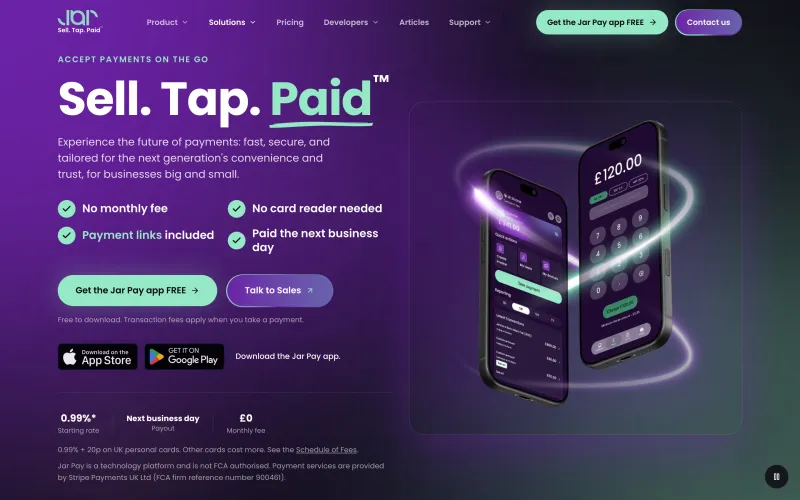
JAR Pay, UK fintech
Concept to live platform in six months. Multi-currency workflows, real-time transaction monitoring, passed independent security audits.
Case studyA build partner, not a development agency
Most development companies ask for the full build cost up front. We work as your technical cofounder instead: you pay a reduced monthly fee while we build, and we recover the rest from a capped share of revenue. You keep the company and the roadmap.
Prefer to talk it through? Book a 30-minute call with Gaurav.
Built and running in production for




Proof
Four products built and running today. Three of them handle money, care or children's data.
JAR Pay, from concept to a live UK fintech platform.
Critical vulnerabilities found in JAR Pay's independent security audits.
Apps and websites shipped since 2018.
Concept to live platform in six months. Multi-currency workflows, real-time transaction monitoring, passed independent security audits.
Case study
AI platform that matches care seekers with culturally aligned care workers. Live.
Case study
SeeMeForMe, a multi-tenant school platform with MFA, role-based access and per-school theming. Live.
Case study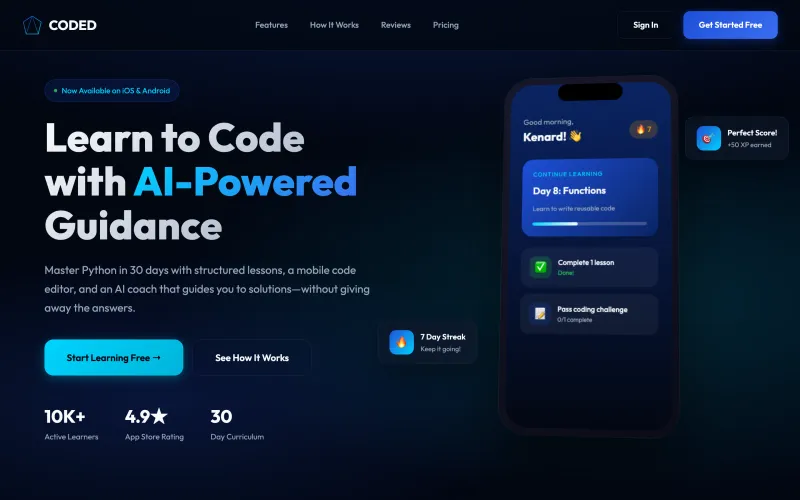
Practice-first coding courses with in-app tests and an AI coach that guides rather than does the work. Live.
Case study"They work as a true partner and extension of our team."
Maaha Suleiman, CEO, CareAlgo
"We would not have started without you."
Ravi Misra, Director, JAR Pay
"They've met every challenge I've given them."
John Theis, Founder and CEO, Whole Student Learning
Rated 4.9 from 4 verified reviews. Read them on Clutch.
The clinician who has watched the same workflow break for ten years and knows exactly what the fix looks like.
The operator who runs the process by hand today, in spreadsheets and phone calls, and has customers asking for the software.
The founder with letters of intent, a deck, and a quote from an agency they cannot justify paying upfront.
A full build needs some cash and pilot customers ready to commit. Not there yet? Three questions show the best first step from where you are.
Why this is different
The build is the same: a written scope, a named lead, working software at every milestone. What changes is who carries the risk after launch.
| Question | A typical development agency | Pixelperinches on Founder's Path |
|---|---|---|
| Cash before the product earns | The full build cost. $75,000 in the example. | Under half. $35,500 in the example: paid scoping, a small working piece first, then a reduced monthly fee. |
| How the rest is paid | There is no rest. You have paid it all. | From a share of the product's revenue, paid monthly. 10% in the example. |
| A slow month | The invoice is the same. | A small month means a small payment. The share is a percentage, not a fixed instalment. |
| When payments stop | When the invoices are paid. | The month the build is paid for. The limit is fixed at signing and never moves. |
| Who owns the company | You. | You. No board seat, no veto. Equity is optional, and many deals have none. |
| Total cost | Lower. Paying upfront is the cheapest way to buy a build. | About 15% higher in the example. That is the price of keeping your cash while the product proves itself. |
If you have the budget and want to own everything at once, Paid Build costs less in total. We will tell you so on the first call.
The numbers
A subscription product sold to businesses, with a first commercial release priced at $75,000. You pay $4,000 for scoping and $7,500 for a working piece of the hardest part, then $3,000 a month for the eight months we build. The rest comes from 10% of the product's revenue until the build is paid for.
Cash from you before the product earns anything.
Paid from the product's own revenue, not your bank account.
Stays in your bank while the product proves itself, compared with paying the same build upfront.
The build starts once paying pilot customers are committed. A smaller build works the same way: a $40,000 build needs $21,500 from you before the product earns. Example numbers only. Yours are fixed in writing before the build starts.
Start here
Answer these and we will show you the best way to start from where you are. Your answers carry over to the application form.
Three ways to pay
Every option runs through the same process and the same team. What changes is how much cash you put in and how the rest is paid. Terms are set per client after scoping; see a sample term sheet.
For domain experts with some cash and pilot customers ready to commit.
For founders with pilot customers who have paid deposits, and no budget.
We take on a few of these each year.
For funded founders and operators who want speed and clean ownership.
How it works
Each step ends with something you can hold: a decision, a document, or working software. The full build path.
Thirty minutes. A straight answer on fit, and which way to pay suits you.
Short and paid. Scope, architecture, cost range and timeline, in writing.
A small fixed-fee build that proves the hardest part works.
Your pilot customers use it. Feedback and first revenue.
The product you can sell.
Questions founders ask
An agency is paid in full for the build whether or not the product sells. On Founder's Path you pay a reduced monthly fee during the build, and the rest comes from a capped share of the product's revenue. If it sells slowly, we are paid slowly. That changes what we agree to build and how carefully we scope it.
The Launch Check is $500 and the Fundraising Tech Pack starts at $3,000. A first commercial release on Paid Build starts from $25k, and most run $40k to $125k. On Founder's Path the same build is paid as a reduced monthly fee and a capped share of revenue, set after scoping and written down before anything starts. Every price is on the pricing page.
A full build needs either some budget or pilot customers who have paid deposits. With paying pilot customers and no budget, Customer-Funded Build has no upfront fee, and we take on a few of these each year. With neither, start smaller. The readiness check is free and shows what to get first. If you can find a few thousand dollars, a Proof of Concept at $4,000 gets one core feature working to show customers and investors.
On Paid Build, you do, in full, on payment. On Founder's Path and Customer-Funded Build, we hold the code until the build is paid for, and you run and sell the product as yours in the meantime. The transfer document is signed on day one and released when the build is paid for, so it is automatic, not a negotiation. Your data is yours throughout. The sample term sheet sets out each step.
No. You keep the company and the roadmap. Where we hold equity it is a minority stake that vests as we deliver, with a maximum fixed at signing and never renegotiated.
It is written into the contract. After a real, sustained effort to sell the product, the unpaid balance is reduced and the rest is spread over an agreed period. The contract does not allow walking away, rebuilding elsewhere or selling the company without settling first. The sample term sheet has the detail.

Who you deal with
I read every application myself, lead every build and sign the agreement.
Before Pixelperinches I worked inside large companies as a developer, then a senior IT consultant, then a CTO. Since 2018 my team and I have shipped around 50 apps and websites, most recently for founders in fintech, care and education.
Three questions, one clear next step, and a form that already knows your answers.
Prefer to talk first? Book a 30-minute call.